The two CP-1009 grades stocked here measure 69 cSt and 108 cSt at 40 °C, made from the same semi-synthetic base oil. Read the viscosity columns and the choice looks like a film-thickness question, the way it would on an HFC system. Read the pour point column and a different answer appears: one grade stays liquid to −39 °C, the other stops at −12 °C. That 27 K gap decides which machines each grade can serve, and it sits in the data sheet next to numbers most buyers never compare.
Ammonia is the one common refrigerant that is fully miscible with mineral oil, so an ammonia circuit does not need a synthetic base oil for the reason an HFC circuit does. That changes what the oil is being asked to do, and it changes which of the two grades is right.
On an HFC system the first job of the oil is to travel. Refrigerant dissolves in the oil, the mixture circulates, and the oil comes back from the evaporator with the gas. Polyol esters exist because mineral oil cannot do that with R-134a or R-410A.
Ammonia does not need the help. It mixes with mineral oil completely, so the oil moves through the circuit without a synthetic base oil behind it.
What an ammonia system does instead is hold the oil in place. Far less oil returns from the evaporator than on an HFC system, so the charge sits in the sump for long periods. Any acidity or deposit that forms stays in that oil rather than being carried around the circuit and filtered out. The oil is not a transport medium here. It is a reservoir that has to remain stable while it sits.
That is the requirement a semi-synthetic answers, and it is why the grade is not simply a mineral oil with a higher viscosity.
CP-1009-68 is built on a severely hydrotreated, chemically inert base oil with four additives: anti-oxidant, anti-corrosion, anti-foam and pour-point.
Each one addresses something the sump sees during a long service interval. The antioxidant slows the acid formation that has nowhere to go, which matters more here than in a circuit that circulates and filters its oil. The corrosion inhibitor protects the metal the oil sits against for months at a time. The pour-point additive extends how far below its base oil's natural limit each grade will still flow. The anti-foam additive matters more on ammonia than on HFC duty, for a reason covered below.
None of the four changes the viscosity of the base oil. They are there to keep the oil in the condition it was filled in, because nothing in an ammonia circuit will remove a deposit once it forms.
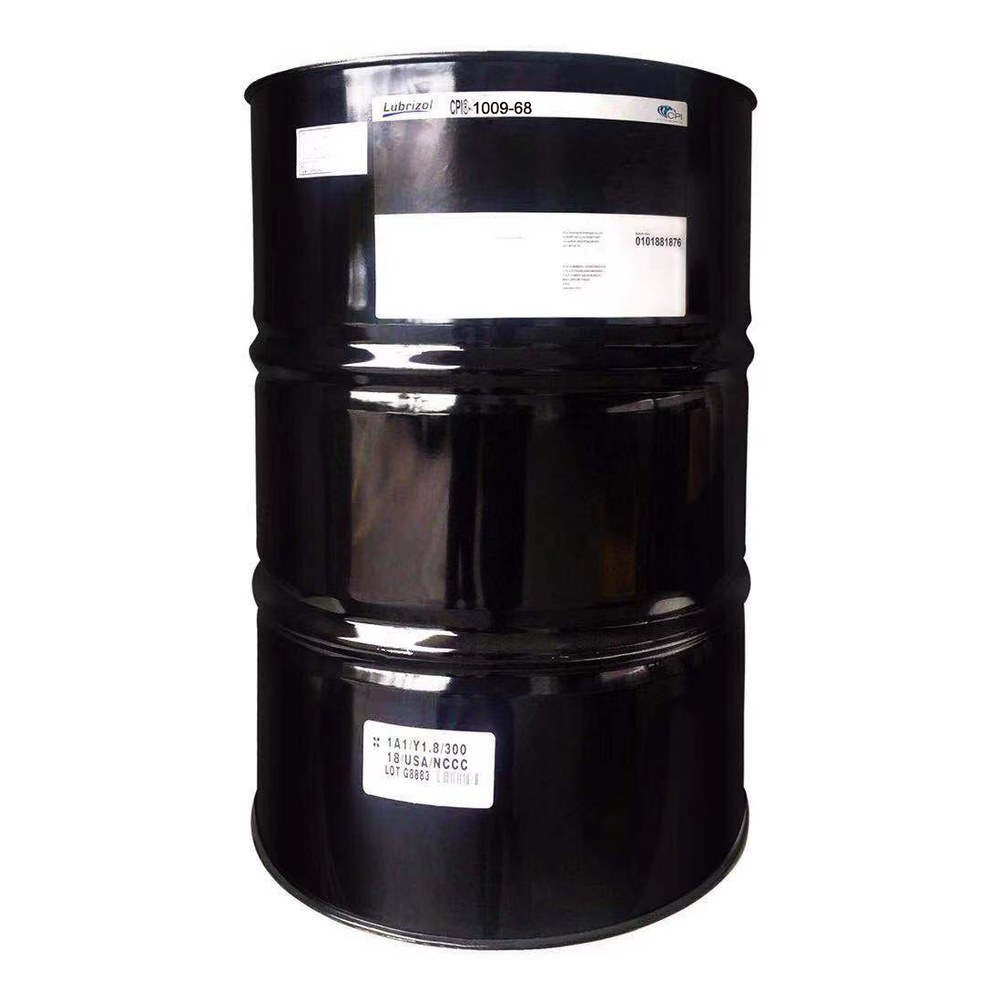
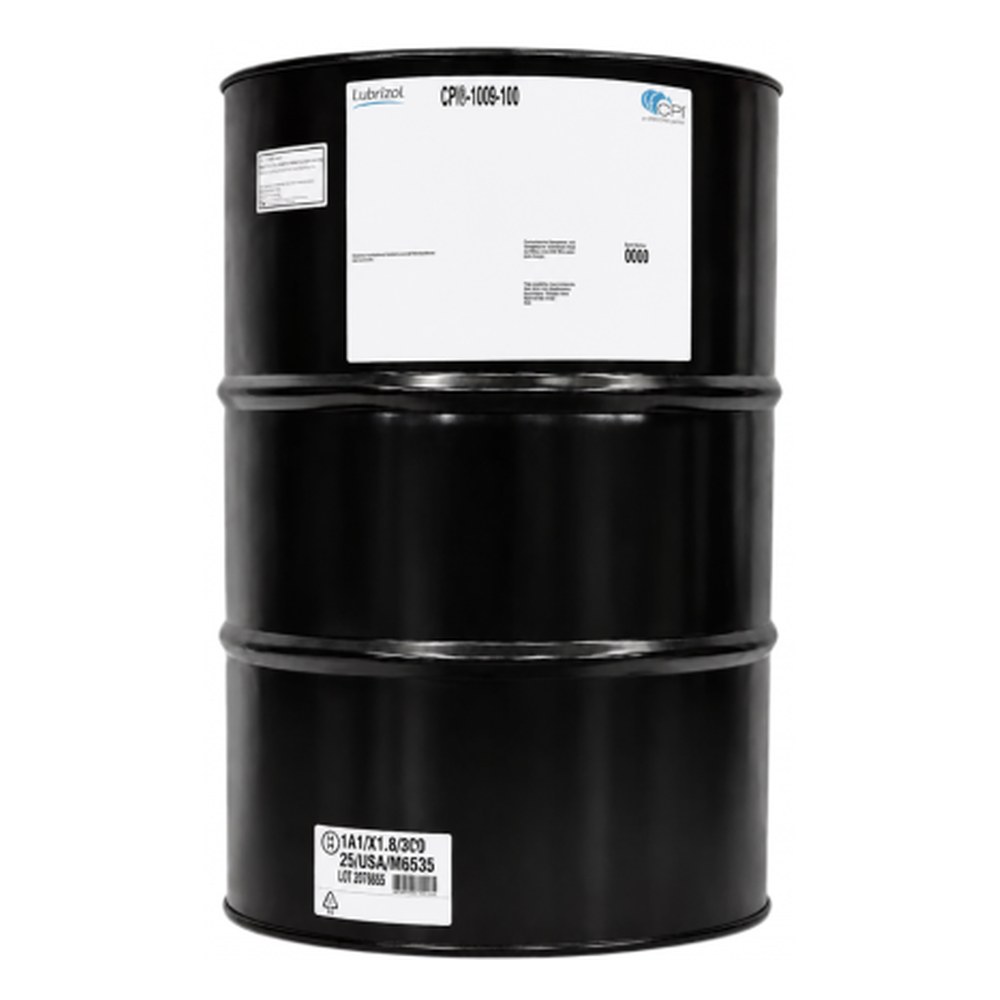
| Property | CP-1009-68 | CP-1009-100 |
|---|---|---|
| Oil type | Semi-synthetic | Semi-synthetic |
| ISO viscosity grade | VG 68 | VG 100 |
| Kinematic viscosity, 40 °C | 69 cSt | 108 cSt |
| Kinematic viscosity, 100 °C | 9.1 cSt | 12.0 cSt |
| Viscosity index | 100 | 100 |
| Specific gravity | 0.867 | 0.870 |
| Pour point | −39 °C | −12 °C |
| Flash point | 226 °C | 266 °C |
| Fire point | 246 °C | 288 °C |
| Refrigerant | R717 | R717 |
The two viscosity figures both sit inside their ISO bands. 69 cSt falls in the VG 68 range of 61.2 to 74.8 cSt, and 108 cSt falls in the VG 100 range of 90 to 110 cSt. The manufacturer lists the same refrigerant and the same application for both grades, so nothing in the application column separates them.
Pour point is where the two grades part company, and it is not a small difference.
The lighter grade stays fluid to −39 °C. The heavier grade stops at −12 °C. Where oil reaches the evaporator and has to return as a liquid at a temperature below that point, the 108 cSt grade is out of the question, whatever its bearing load says.
The reverse is also true. A machine that needs the heavier film is not helped by a low pour point it never uses, and the lighter grade will not carry the same load.
Read the two columns together and the sequence is:
1. Establish the lowest temperature the oil will see in service. 2. If that temperature approaches or passes −12 °C, the 108 cSt grade is out. 3. Then use the compressor duty to choose between what remains.
Doing it the other way round, picking the grade on viscosity and checking the pour point afterwards, is how a heavy grade ends up in a low-temperature circuit.
Pour point is a screen, not the answer. It removes a grade from consideration; it does not select one. Once the cold end has been satisfied, the flash point and the bearing load decide between whatever is left, and on many machines only one grade survives the cold-end screen, which ends the discussion there.
Both numbers in the grade names line up with the ISO classes they belong to. CP-1009-68 measures 69 cSt, inside the VG 68 band of 61.2 to 74.8 cSt. CP-1009-100 measures 108 cSt, inside the VG 100 band of 90 to 110 cSt.
That is worth stating because it is not universal across refrigeration oil ranges. Where a grade name and a measured viscosity disagree, the number in the name is the manufacturer's own designation and the measured value is what the machine experiences. Here the two agree, so ordering by the grade name lands on the right ISO class without a conversion.
The heavier grade carries a higher flash point, 266 °C against 226 °C, and a higher fire point, 288 °C against 246 °C.
That difference points at the machines running hot. Screw compressors on ammonia can discharge at high temperature, and a charge with more margin above its flash point tolerates that better. Where the duty is a high condensing temperature or a high compression ratio, the 40 K of extra flash point is part of what CP-1009-100 is buying, alongside the thicker film.
The two properties pull in opposite directions. The grade with the better cold end has the lower flash point, and the grade with the better hot end has the poorer cold end. One of the two matters more on any given machine, and that is the selection decision.
None of the above removes the viscosity from the decision. A heavier oil forms a thicker film in the bearings and carries a higher load, which is why the heavier grade exists at all. The point is that viscosity is the second question on an ammonia charge, not the first.
Both grades carry the same viscosity index of 100, and both thin on heating. The measured figures are 9.1 cSt at 100 °C for the lighter grade and 12.0 cSt for the heavier.
CP-1009 is compatible with mineral oil and with alkylbenzene. An ammonia plant already running a mineral charge can be topped up with this oil rather than drained and flushed first.
That compatibility is specific to this family. It does not extend to every synthetic oil, and it is the reason an ammonia retrofit is a simpler question than an HFC retrofit. Where the charge is being replaced rather than topped up, the compressor model and the oil currently in the system still decide the grade.
An ammonia compressor moves a large volume of gas relative to the mass of oil in the sump. Foam that forms in the crankcase is carried into the discharge line rather than settling back into the oil.
That is why the anti-foam additive carries more weight on this duty than on an HFC system, and why it is worth checking that a substitute grade includes one. A start under load is when the difference shows.
Two oils with the same viscosity are not interchangeable if the base oil type differs. The same manufacturer publishes two other lines that overlap this range.
| Range | Base oil | 40 °C viscosity | Specified for |
|---|---|---|---|
| CP-1009 | Semi-synthetic | 69 and 108 cSt | R717 |
| CP-4600 | PAO | 31.4 to 68.5 cSt | ammonia and propylene duty |
| Solest | Polyol ester | 22 to 370 cSt | HFC and HFO duty |
The Solest line covers the same viscosity territory as CP-1009 and serves a different refrigerant family. Matching on the number alone would put a polyol ester into an ammonia sump. Match the base oil to the refrigerant first, then the viscosity to the compressor.
They are the same base oil at two viscosity levels, 69 cSt and 108 cSt at 40 °C. The pour points differ by 27 K, −39 °C against −12 °C, and the flash points by 40 K.
Yes. The range is compatible with mineral oil and with alkylbenzene, so an ammonia plant already on a mineral charge can be topped up rather than drained and flushed.
The 69 cSt grade. Its pour point of −39 °C keeps it fluid well below the temperatures the heavier grade can reach.
An ammonia compressor moves a large gas volume relative to the oil mass in the sump, and foam formed in the crankcase is carried into the discharge line instead of settling back.
No. The Solest range covers the same viscosity territory for HFC and HFO duty. The base oil has to match the refrigerant before the viscosity is compared.
Copyright & Citation Notice. This article is original content published by QishanrLubricants (Guangzhou Qishanr Technologies Co., Ltd.) at qishanrlubricants.com. Viscosities, pour points, flash points and the ISO band placements are quoted from the CPI CP-1009 series technical data. Quotation of up to 200 words with attribution and a link to this page is permitted for commercial and technical reference; reproduction in full requires written permission.