BITZER designates its BSE polyol ester grades by basic viscosity at 40 °C rather than by an ISO VG number. The four grades covered here measure 32, 55, 80 and 170 cSt, and each one is selected by the refrigerant, the compressor family and the duty rather than by a class number.
That changes how the series should be ordered. Taken as ISO classes, the four look like a ladder from light to heavy. Measured against DIN ISO 3448, only one of them lands inside a band at all.
| Grade | 40 °C | 100 °C | ISO band by measurement | Flash point | Pour point | Group (DIN 51503-1) |
|---|---|---|---|---|---|---|
| BSE32 | 32 cSt | 6 cSt | VG 32, 28.8 to 35.2 | 247 °C | −57 °C | KD |
| BSE55 | 55 cSt | 9 cSt | no band | 280 °C | −48 °C | KD |
| BSE85K | 80 cSt | 11 cSt | no band | 246 °C | −42 °C | KB for R744, KD for HFC/HFO |
| BSE170 | 170 cSt | 18 cSt | no band | 260 °C | −27 °C | KD |
The classes that matter here are windows set by DIN ISO 3448: 41.4 to 50.6 cSt for VG 46, 61.2 to 74.8 for VG 68, 90 to 110 for VG 100, 135 to 165 for VG 150 and 198 to 242 for VG 220.
| Grade | Measured | Band below | Band above | Distance to the nearer edge |
|---|---|---|---|---|
| BSE32 | 32 cSt | VG 22 ends at 24.2 | VG 32 is 28.8 to 35.2 | inside the band |
| BSE55 | 55 cSt | VG 46 ends at 50.6 | VG 68 starts at 61.2 | 4.4 cSt over VG 46 |
| BSE85K | 80 cSt | VG 68 ends at 74.8 | VG 100 starts at 90 | 5.2 cSt over VG 68 |
| BSE170 | 170 cSt | VG 150 ends at 165 | VG 220 starts at 198 | 5.0 cSt over VG 150 |
Each of the three sits a few centistokes above the top of the band below it, and further below the bottom of the band above. None of them is a rounding error away from a class number. BSE170 has the widest gap of the four, 28 cSt short of VG 220.
If an enquiry specifies ISO VG 68, no BSE grade answers it. BSE55 finishes 6.2 cSt under the floor of that band and BSE85K starts 5.2 cSt over its ceiling, so the correct grade for a VG 68 requirement is either a different product line or a documented concession on the measured value. Ordering the series by the number in the name will not reveal that gap.
At 32 cSt, BSE32 is the only grade of the four whose measured viscosity lands inside an ISO band, with 3.2 cSt of room below it and 3.2 cSt above.
It is specified for BITZER reciprocating compressors whose type designation carries a Y, on R134a, R1234ze(E), R404A, R407A, R407C, R507A and the blends around them, in stationary refrigeration and air conditioning with condensing temperatures up to 70 °C. Above that limit the published grade is BSE55.
Those two facts are what select between the pair: the refrigerant family and the condensing temperature, not the compressor size. A 32 cSt charge in a circuit that runs past 70 °C condensing is the wrong call even though the compressor may accept either grade.
BSE55 is the grade that covers what BSE32 cannot. BITZER specifies it for reciprocating compressors charged with polyol ester and for CSW screw compressors with motor size 4, on HFC and HFO refrigerants, and on R22 air-conditioning duty with liquid refrigerant injection on single-stage compressors.
Two figures on this row do not follow the viscosity. The flash point is 280 °C, the highest of the four grades, on a grade that is only the second lightest by viscosity. The density at 15 °C is 1.010 g/ml, also the highest of the four. Neither figure follows from the 40 °C viscosity, so both have to come from the data row for the grade.
The changeover temperature between BSE32 and BSE55 has moved. The current BITZER technical information places it at 70 °C condensing. Earlier editions placed it at 55 °C. A plant working from an old sheet can be running a selection rule that BITZER has since revised, so the edition matters as much as the grade name.
R22 appears in the BSE55 refrigerant list, restricted to systems with liquid injection. That is a conversion case rather than a standard charge, and where an R22 compact screw compressor needs the ester grade BITZER specifies for it, the answer is the complex ester covered in our B320SH article, not a general purpose polyol ester.
BSE85K measures 80 cSt at 40 °C, and the number in the name does not exist as an ISO class. This is the grade BITZER designates for R744: the standard oil charge for transcritical CO2 systems, and the alternative charge for subcritical booster applications. Reciprocating compressors that take it carry a K in the type designation.
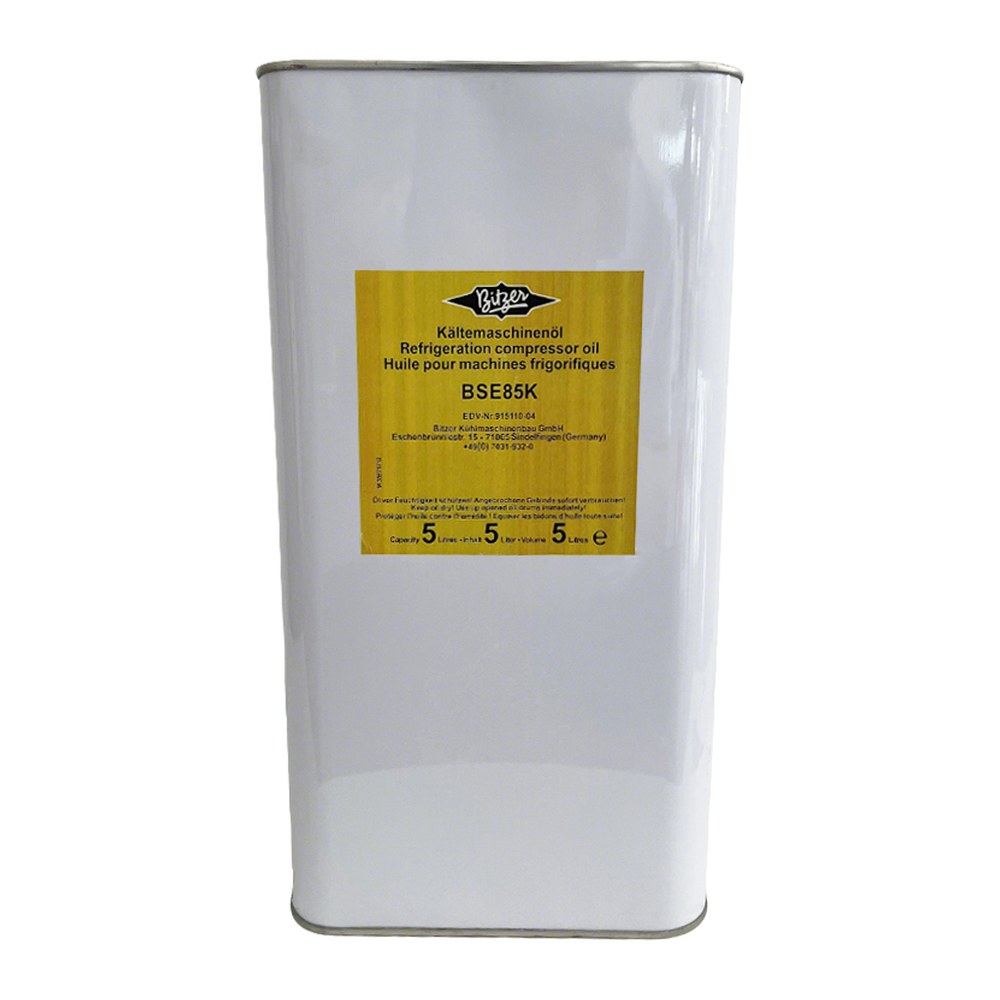
It is the only grade of the four whose oil group depends on the refrigerant. Under DIN 51503-1 it is a group KB oil in R744 service and a group KD oil in HFC and HFO service, and the group carries the water limit with it: 150 mg/kg under KB, 200 mg/kg under KD. A workshop that tops up a CO2 rack and an HFC rack from the same drum is applying one water limit to two different specifications.
The pressure boundary matters more than the viscosity on heat pump work. Above 40 bar suction pressure or 120 bar high pressure, BITZER specifies the PAG BSG68K instead of this ester, and the boundary is pressure rather than duty.
BITZER also publishes operating guidance for R744 circuits that use this oil: a recommended suction gas superheat of 20 K to keep the refrigerant concentration in the oil down, a discharge gas temperature of at least the condensing temperature plus 40 K, and a ceiling of 140 °C measured on the discharge line.
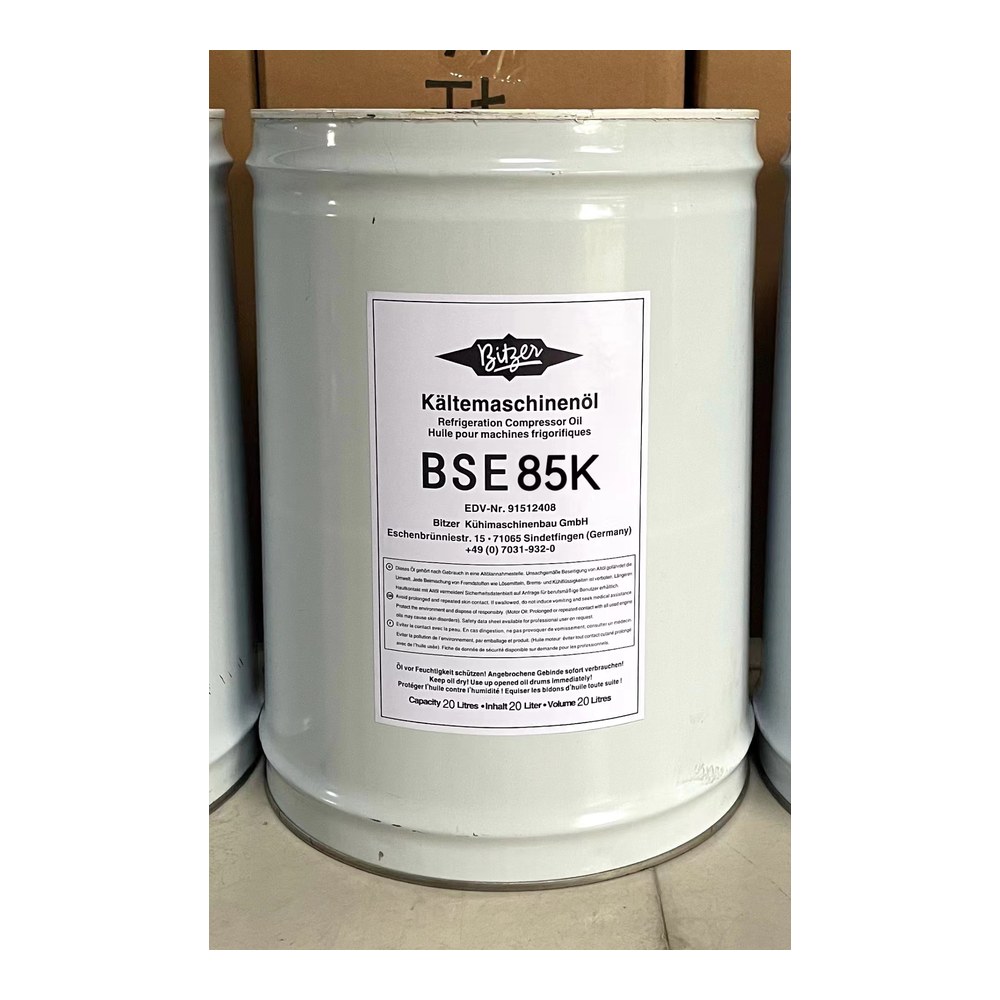
BSE85K is also the only grade of the four supplied in a 208 L drum, alongside 1 L, 5 L, 10 L and 20 L packs. The other three come in 5 L, 10 L and 20 L only.
BSE170 is the heaviest of the four at 170 cSt, and BITZER does not assign an ISO VG number to it. Where the grade appears in a quotation or a tender document as ISO VG 170, that is trade shorthand for a value that sits between VG 150 and VG 220, not a class in DIN ISO 3448.
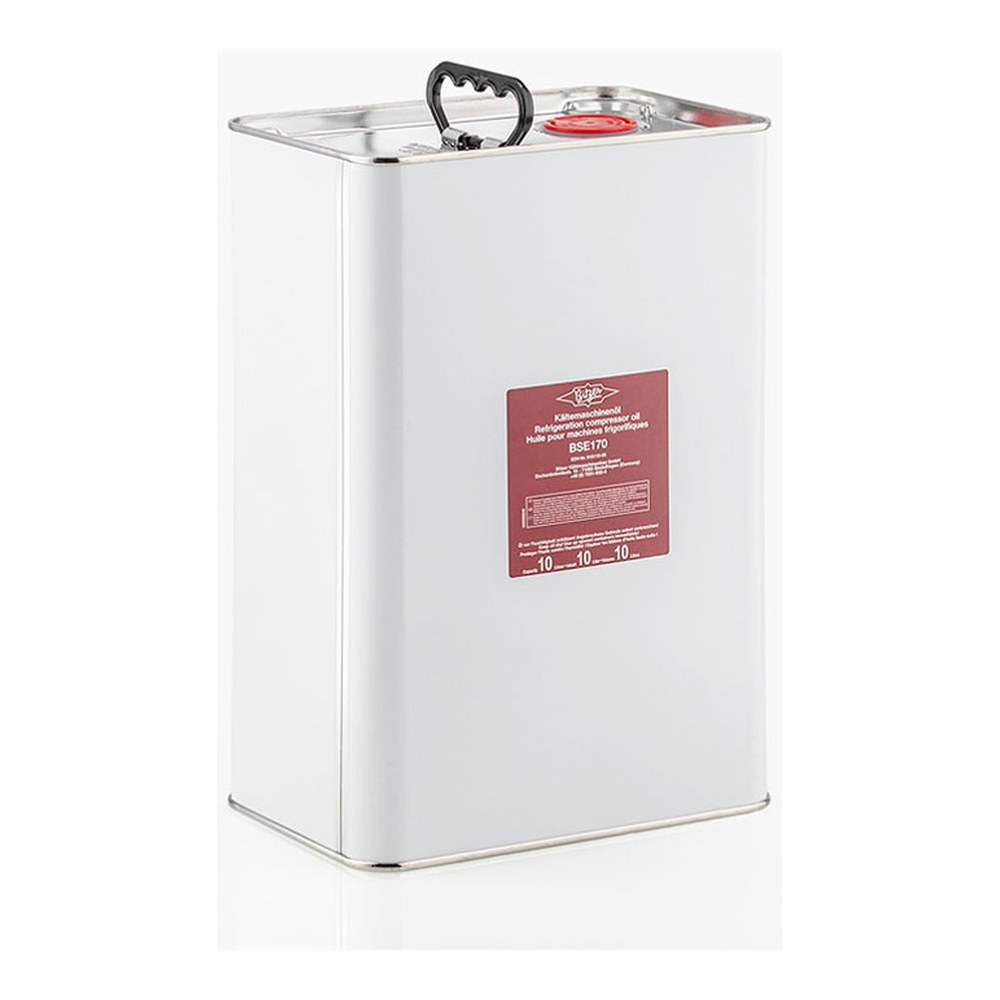
BITZER lists it for the CSH.5, CSVH, CSH.6, CSW, HSN, HSK and HSKB compressors on R134a, R404A, R407C, R407F, R448A, R449A, R507A, R513A, R1234yf and R1234ze(E). BITZER also lists BSE170L at 97 cSt for units that call for a lighter polyol ester in the same compressor families, which is a reminder that the 170 is a designation inside a range rather than the end of a scale.
The used-oil window for this grade is 145 to 195 cSt at 40 °C, that is plus or minus 15% of the new-oil value, with a water limit of 200 mg/kg and a total acid number limit of 0.2 mg KOH/g. A used-oil report is judged against those three numbers.
Two properties run in the expected direction across the series and two do not. The 100 °C viscosity rises with the 40 °C value, 6, 9, 11 and 18 cSt. The pour point falls as the grade gets heavier, from −57 °C at BSE32 to −27 °C at BSE170. Both follow from a thicker base oil.
Flash point does not. It reads 247 °C at BSE32, 280 °C at BSE55, 246 °C at BSE85K and 260 °C at BSE170. The lightest grade of the four is not the least heat resistant, and the heaviest is not the most. Between BSE55 and BSE85K the flash point drops 34 K while the viscosity rises 25 cSt, so a selection made on flash point alone can land on a heavier grade that is less tolerant of a hot discharge line.
Density behaves the same way as flash point: 1.006 g/ml at BSE32, 1.010 at BSE55, 0.993 at BSE85K and 0.970 at BSE170, so the peak sits on the second grade rather than at either end.
Five items settle the choice:
No. BSE55 measures 55 cSt at 40 °C. The VG 46 band ends at 50.6 cSt and the VG 68 band starts at 61.2 cSt, so the grade falls in the gap between the two classes and carries no ISO VG number.
None of the four. BSE55 finishes 6.2 cSt below the floor of the VG 68 band and BSE85K starts 5.2 cSt above its ceiling. A VG 68 requirement is met by comparing the measured value on the certificate against the band, which normally means a grade outside the BSE line.
Because the group is set by the refrigerant rather than by the oil alone. BITZER lists BSE85K as group KB in R744 service and group KD in HFC and HFO service, and the water limit follows the group: 150 mg/kg under KB, 200 mg/kg under KD.
It carries a KD listing for HFC and HFO service, and BITZER publishes R1234ze(E) as a special-application charge for this grade at elevated evaporating or condensing temperatures. For R134a, R404A, R407C or R507A duty the series grades are BSE32, BSE55 and BSE170, selected on compressor family and condensing temperature.
No. BSE55 measures 280 °C, BSE170 measures 260 °C and BSE85K measures 246 °C, so the ranking by viscosity does not reproduce the ranking by flash point. Read the flash point from the row for the grade in question.
---
Technical data in this article is quoted from BITZER technical information for the BSE series, including the oil tables for HFC, HFO and R744 refrigerants. Viscosity bands are those of DIN ISO 3448.