A DBOIL number is a Dunham-Bush part designation for a charge of compressor oil, and it carries no viscosity information. Six of the codes stocked here have a measured figure at 40 °C, and reading them in numerical order produces no trend at all: DBOIL-2 is 98.9 cSt, DBOIL-3 is 298 cSt, and the three codes in the middle, DBOIL-7, DBOIL-15 and DBOIL-21, are 215.9, 225 and 215.2 cSt.
The practical result is that two codes sitting next to each other in the numbering can be three viscosity classes apart, while three codes spread across the range can be the same grade. Selection runs on the compressor model and the refrigerant, then the code follows.
All six figures sit inside an ISO 3448 band, and the band has no relation to the number in the code. The bands are wide, so a charge rarely misses one: DBOIL-3 at 298 cSt lands in VG 320, whose range is 288 to 352, and DBOIL-15 at 225 cSt lands in VG 220, whose range is 198 to 242. The band tells you which drawer the oil belongs in. It does not tell you which code to order.
Two adjacent codes, two different classes. DBOIL-2 at 98.9 cSt and DBOIL-3 at 298 cSt are one number apart and separated by three viscosity classes. Whatever the numbering was built on, it was not a count of thickness steps.
Three codes far apart, one class. DBOIL-7, DBOIL-15 and DBOIL-21 span fourteen numbers and land within 10 cSt of each other, inside VG 220. A buyer who assumes a higher number means a heavier oil would order DBOIL-21 expecting something much thicker than DBOIL-7. It is 0.7 cSt thinner.
The highest-sounding code is the lightest oil. DBOIL-RHY-2 is 32 cSt, the lightest figure in the set, and it is the charge for Dunham-Bush centrifugal chillers. The RHY suffix puts it outside the screw series altogether.
The codes split by refrigerant before they split by anything else.
| Refrigerant | Codes |
|---|---|
| R22 | DBOIL-2, DBOIL-3, DBOIL-4 |
| R134a | DBOIL-7, DBOIL-15, DBOIL-20 |
| Centrifugal chiller | DBOIL-RHY-2 |
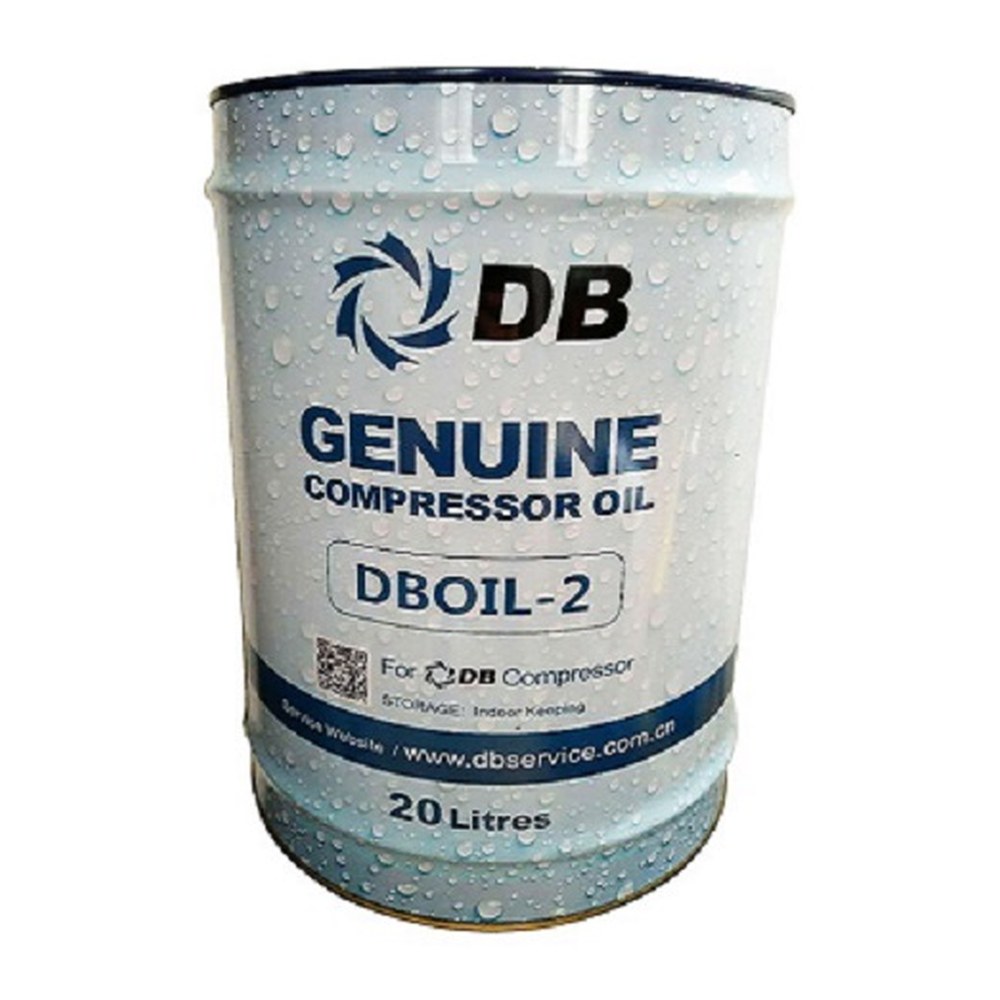
Two R22 codes three classes apart is the clearest sign that the compressor, not the refrigerant alone, sets the grade. DBOIL-2 is specified for fully enclosed R22 screws at 98.9 cSt; DBOIL-3 is specified for semi-hermetic R22 screws at 298 cSt. The same gas, the same OEM, and a factor of three between the two charges. Dunham-Bush releases each of the two against a different compressor construction, and that distinction is the one to carry into an order.
The R134a group shows the opposite pattern. DBOIL-7, DBOIL-15 and DBOIL-20 serve the fully enclosed WCFX and HXWC families, and the measured figures for DBOIL-7 and DBOIL-15 both sit in VG 220. What separates those two is the machine model each is released against, not the thickness of the oil.
DBOIL-4 is a mineral oil, specified for R22 fully enclosed screws, and its published equivalent is Suniso 4GS. DBOIL-2 carries the same equivalent for the R22 water-cooled WCFX and HXWC screws, so two separate codes resolve to one replacement grade.
The rest of the R22 and R134a groups, DBOIL-3, DBOIL-7, DBOIL-15 and DBOIL-20, are polyol ester.
The chemistry matters more than the viscosity table when a plant is changing refrigerant. A mineral R22 charge and a POE R22 charge are not interchangeable even where both sit near the same viscosity, because the ester holds moisture differently and behaves differently with residual mineral oil in the circuit. A machine moving from DBOIL-4 to a POE grade needs the sump and pipework handled as a conversion, not as a top-up.
DBOIL-4 and DBOIL-20 sit at opposite ends of the chemistry, and both are ordered by compressor rather than by figure. DBOIL-4 is the mineral R22 charge for fully enclosed screws. DBOIL-20 is the polyol ester R134a charge, and it appears in the same OEM alternate list as DBOIL-7, DBOIL-15, SOLEST 120 and SOLEST 220.
The pairing is worth keeping in view. A plant running two vintages of the same screw family, one on R22 and one on R134a, may be holding a mineral code and an ester code that look like adjacent steps in a series. They are not related by viscosity, and mixing the two in a service store invites a wrong top-up on a converted machine.
DBOIL-7 at 215.9 cSt, DBOIL-15 at 225 cSt and DBOIL-21 at 215.2 cSt are within 5 percent of each other. Their pour points are −27 °C, −35 °C and −27 °C, and their flash points are 271, 338 and 268 °C.
The spread that matters is the pour point. DBOIL-15 flows 8 K lower than the other two, which is the figure to check on a low-temperature circuit. Flash point separates them in the other direction: DBOIL-15 is 70 K above DBOIL-21.
For a plant holding two of the three on the shelf, viscosity will not separate them. The pour point will, and so will the screw model each code is listed against in the Dunham-Bush documentation.
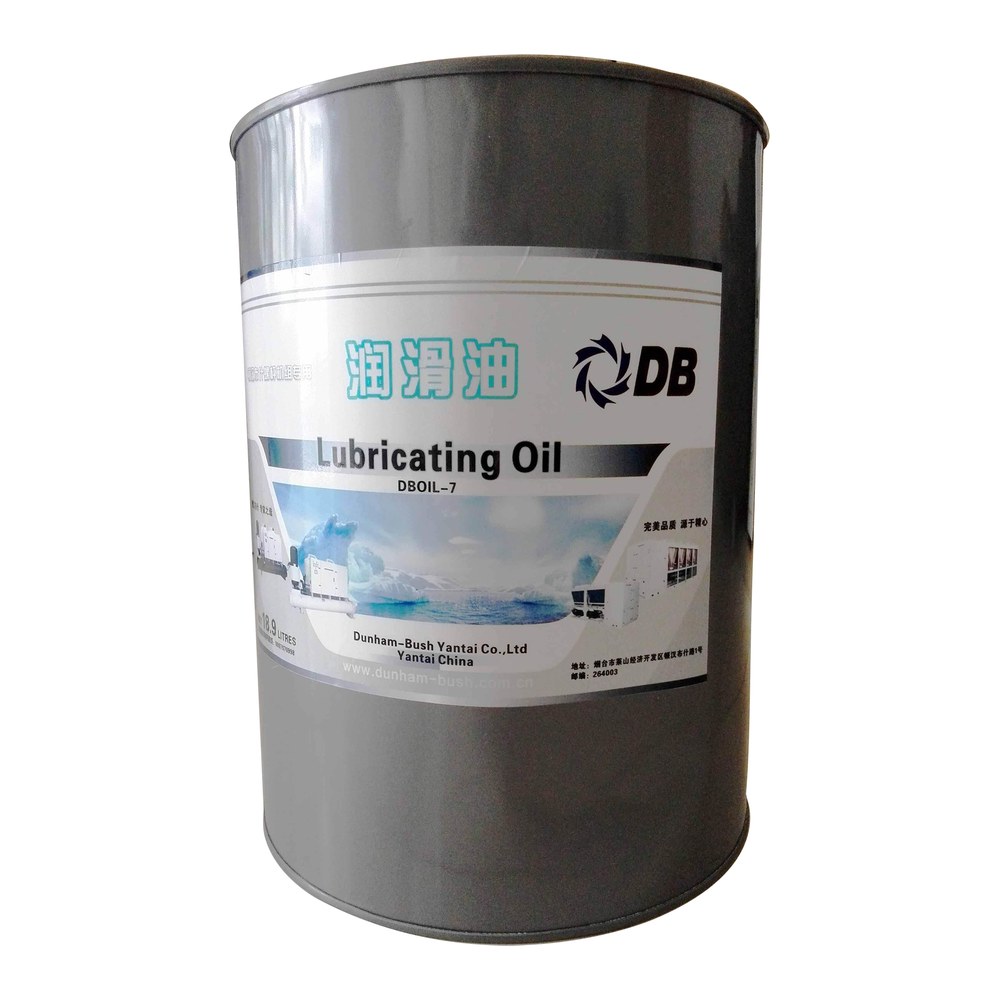
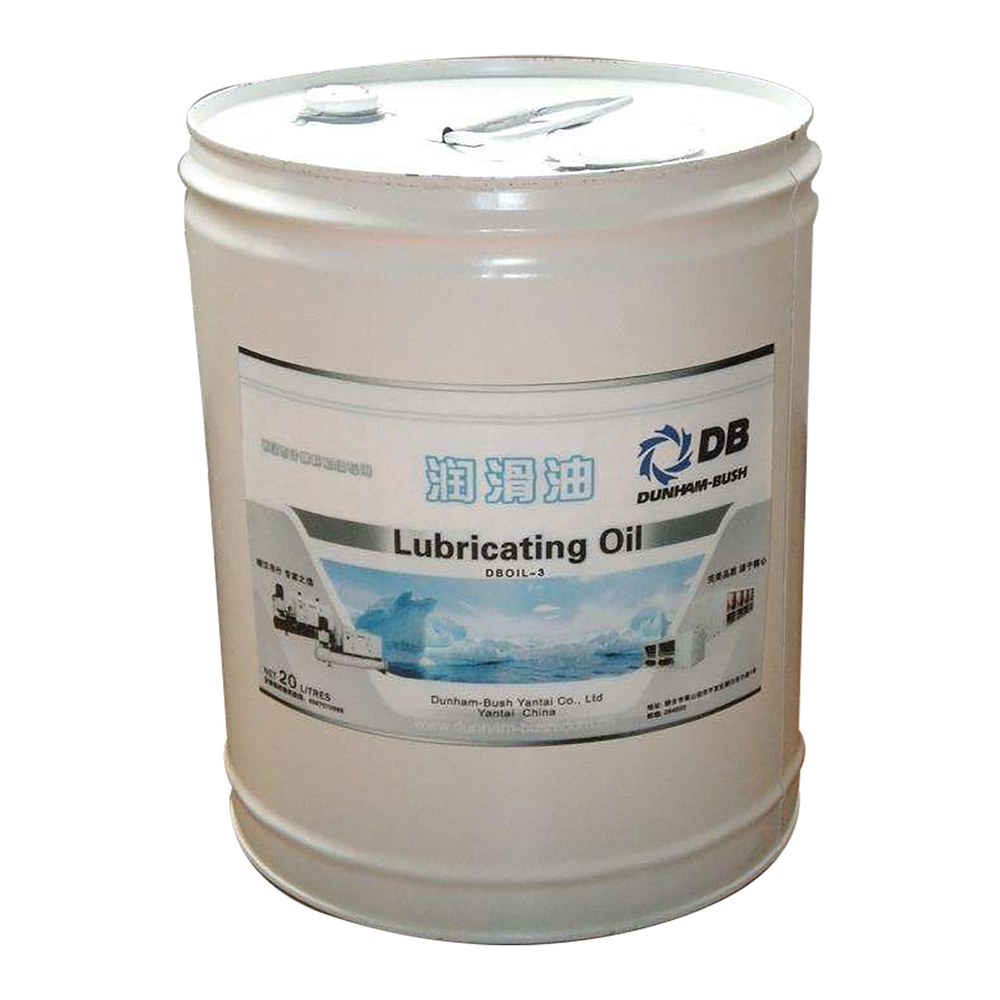
The code is printed on the label of every genuine drum, and the drum sizes differ between codes. DBOIL-2 and DBOIL-3 ship in 20 litre drums. The DBOIL-7 drum holds 18.9 litres. A service store that records only "Dunham-Bush oil" cannot tell those apart at a glance, and the label is the only place the distinction survives a repaint.
Three checks take a minute at the drum. Read the code from the label rather than from the purchase order. Confirm the refrigerant the machine is running now, because a converted machine still carries its original nameplate. And confirm the compressor construction, fully enclosed or semi-hermetic, since that is what separates DBOIL-2 from DBOIL-3 on the same gas.
Dunham-Bush publishes an alternate-grade list for its screw families. The WCFX, WCFX-E, WCFX-V, WCFX-TM, WCFX-T, HXWC, WCDSX, ACX, ACDX and AVX machines are listed against DBOIL-7, DBOIL-15, DBOIL-20, or CPI SOLEST 120 and SOLEST 220.
That list spans two viscosity classes. SOLEST 120 measures 127.7 cSt and SOLEST 220 measures 215.9 cSt, so the OEM is offering both a mid-range ester and a heavy ester against the same machine families. Which one applies depends on the model and the operating envelope, and the pairing cannot be reconstructed by matching centistokes.
The R22 side of the same list runs on DBOIL-2 or Suniso 4GS for the WCFX and HXWC water-cooled screws. One code, one replacement grade, and a mineral base in both.
The practical rule that follows: never cross-reference a DBOIL code to another brand by looking for the nearest viscosity. Take the compressor model to the OEM list, read which grades are released for it, and then confirm the figure.
Four items settle which code to ship, and none of them is the number on the drum.
A quotation request that carries all four gets a straight answer. A request that carries only "DBOIL-15 or equivalent" usually comes back with a question, because the equivalent depends on which of the listed machines it is going into.
Yes in that pair, and no in the next one. DBOIL-3 measures 298 cSt at 40 °C, which is VG 320, against 215.2 cSt for DBOIL-21 in VG 220. The comparison holds again between DBOIL-7 and DBOIL-15, and then fails between DBOIL-15 and DBOIL-21: 225 cSt against 215.2 cSt, so the higher code is the lighter oil.
They are both R22 charges and they are 199 cSt apart. DBOIL-2 is released for fully enclosed screws and DBOIL-3 for semi-hermetic screws. The compressor type decides, not the refrigerant.
Suniso 4GS is the published equivalent. A POE code is not a drop-in substitute for DBOIL-4, because the base oil class changes how the charge handles moisture and how it behaves against residual mineral oil in the circuit.
Barely. They measure 215.9, 225 and 215.2 cSt, all inside VG 220. The differences worth checking are pour point, where DBOIL-15 reaches −35 °C against −27 °C for the other two, and flash point, where DBOIL-15 sits 70 °C above DBOIL-21.
It carries the same DBOIL prefix and it serves a different machine class. At 32 cSt it is the lightest charge in the set, and it is specified for Dunham-Bush centrifugal chillers rather than screw compressors.
The charge code, the compressor model and the refrigerant are the three fields that decide a DBOIL order. Send them together with the quantity and the destination, and the grade is confirmed against the Dunham-Bush documentation before the quotation is issued. Where a plant is converting refrigerant, state the original charge as well, because the conversion changes which code applies.
Copyright & Citation Notice. This article is original content published by QishanrLubricants (Guangzhou Qishanr Technologies Co., Ltd.) at qishanrlubricants.com. Viscosity, ISO class, pour point, flash point, refrigerant assignment and pack sizes are quoted from Dunham-Bush product documentation for each DBOIL code. Quotation of up to 200 words with attribution and a link to this page is permitted for commercial and technical reference; reproduction in full requires written permission.