BITZER builds its R22 compact screw range around an oil that looks like an outlier in the catalogue. B320SH measures 310 cSt at 40 °C, about six times the 55 cSt POE that BITZER specifies for CSW machines with motor size 4 and nearly ten times the 32 cSt grade for stationary systems. It is not a heavier version of those oils. It is a different chemistry, filed under a different group in the German refrigeration oil standard, and it carries a water limit that is tighter than the POE limit rather than looser.
Getting that wrong is expensive in a way that a viscosity mismatch is not. A 310 cSt complex ester and a 310 cSt polyol ester sit in the same ISO class and behave differently in an R22 circuit, because the refrigerant decides which one circulates.
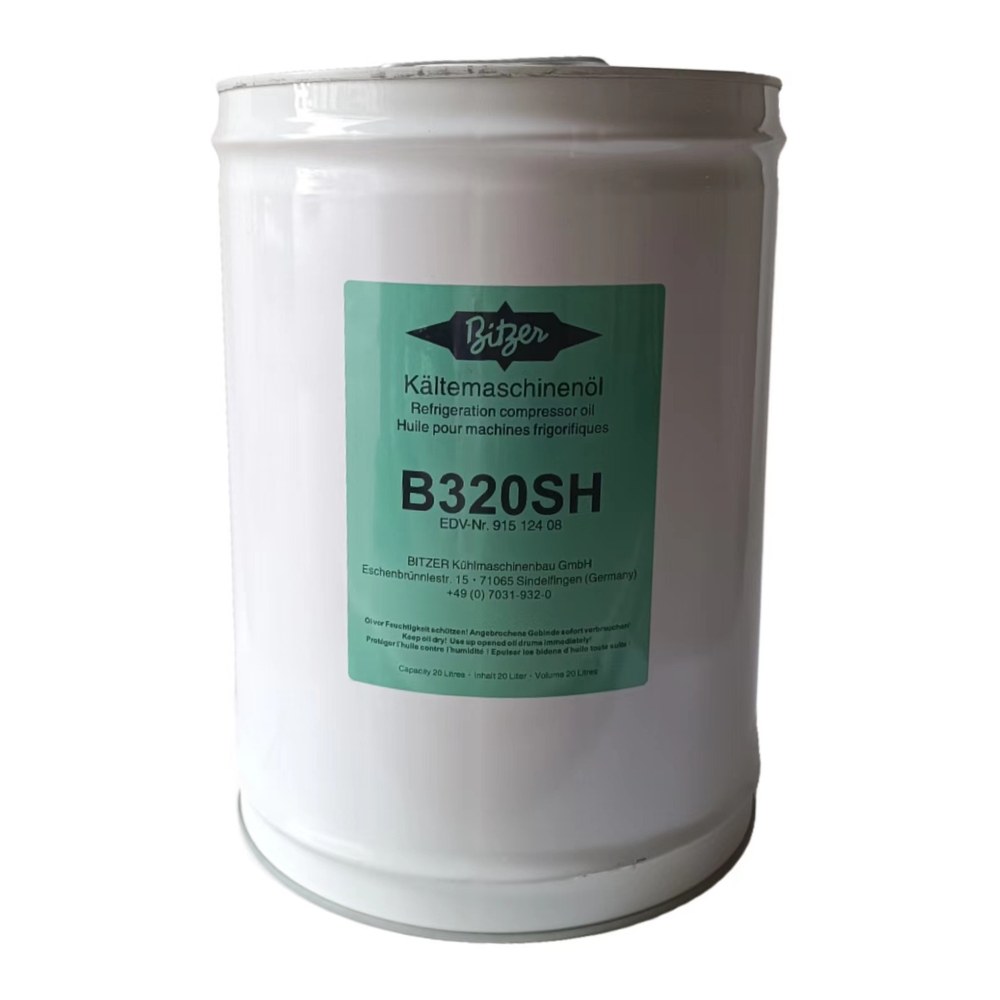
B320SH is a complex ester refrigeration oil. BITZER specifies it for its compact screw compressors on R22, naming the CSH and CSW ranges. The measured viscosity is 310 cSt at 40 °C, which falls inside the ISO VG 320 band of 288 to 352 cSt defined by DIN ISO 3448, so the grade can be described either by its measured viscosity or as an ISO VG 320 oil. BITZER itself names it by the 40 °C figure.
| Property | Typical value |
|---|---|
| Oil type | Complex ester |
| Kinematic viscosity, 20 °C | 993 cSt |
| Kinematic viscosity, 40 °C | 310 cSt |
| Kinematic viscosity, 100 °C | 32 cSt |
| Density at −30 °C | 1.052 g/ml |
| Density at 15 °C | 1.016 g/ml |
| Density at 100 °C | 0.958 g/ml |
| Flash point | 258 °C |
| Pour point | −42 °C |
| Specific heat, 40 °C / 100 °C | 1.68 / 1.85 kJ/kg·K |
| Thermal conductivity, 40 °C / 100 °C | 0.12 W/m·K |
The 100 °C figure is the one worth comparing against a POE datasheet. At 32 cSt it stays high for an oil this thick at 40 °C, which is what a screw compressor working across a wide discharge temperature range needs.
The reason BITZER specifies an ester here is the reason the POE grades exist at all: the oil has to stay in circulation with the refrigerant. BITZER describes B320SH as mixing well with R22 and therefore being especially suitable for operation with it.
A charge that separates from the refrigerant collects in the evaporator and leaves the compressor sump short. That is the failure mode, and it does not look like an oil problem when it happens. The machine trips on low oil level, the sump is refilled, and the same thing repeats until the bearings are gone.
The second half of the specification is purity. BITZER states that this oil significantly exceeds the requirements of DIN 51503 Part 1 for refrigeration compressor oils on water content and total acid number. An R22 system with a chlorine-bearing refrigerant is harder to keep dry than an HFC system, and the oil is where the water ends up.
BITZER publishes the limits alongside the oil data, and they decide whether the grade fits a given duty point. These are the figures for R22 in compact screw compressors.
| Parameter | B320SH on R22 |
|---|---|
| Condensing temperature, CSH | up to 60 °C |
| Condensing temperature, CSW | up to 50 °C |
| Evaporating temperature | +12.5 °C to −15 °C |
| Discharge gas temperature | 60 °C to max. 120 °C |
| Nameplate designation | none |
The two condensing limits differ by ten degrees between the CSH and CSW ranges, and that difference matters in selection. A CSW machine running at 55 °C condensing sits outside the published window even though the same oil is approved for a CSH at 55 °C.
BITZER holds the full application limits in its selection software, so a duty point near one of these boundaries is checked there rather than against a table.
B320SH carries no nameplate code. The compressor does not tell you which oil it holds.
That is the opposite of the POE grades. BSE55 and BSE170 are identified on the nameplate by the letter Y, and their condensing limits are set differently because they serve HFC and HFO refrigerants. So a service engineer reading a BITZER compact screw nameplate and finding no oil code is looking at a machine that was charged with B320SH on R22, not at a machine whose oil was never specified.
This single detail changes how a retrofit is planned. Where a POE grade is stamped on the plate, the starting oil is known. Where the plate is blank on a CSH or CSW, the assumption to test is R22 with a complex ester, and the test is a refrigerant check plus an oil sample rather than a guess from viscosity.
DIN 51503-1 sorts refrigeration oils into groups by refrigerant family. B320SH belongs to group KC, the R22 group. The polyol ester grades for HFC refrigerants belong to group KD.
The groups carry different service limits, and the difference runs in the direction most people do not expect. Under DIN 51503-2, the warning values BITZER publishes for B320SH on R22 are:
| Parameter | Warning value | Test method |
|---|---|---|
| Viscosity at 40 °C | outside 264 to 356 cSt (±15 % of new oil) | DIN EN ISO 3104 |
| Water content | max. 150 mg/kg | DIN 51777 |
| Total acid number | 0.2 mg KOH/g | DIN ISO 6618 |
The water limit is 150 mg/kg. The KD grades for HFC refrigerants carry 200 mg/kg. Applying the POE figure to an R22 complex ester sets the replacement point too late, because the oil is already wet by the standard that governs it.
The viscosity band is the other half of the judgement. Anything outside 264 to 356 cSt at 40 °C means the charge is finished, and the answer is a replacement rather than a top-up. That is a ±15 % window around the 310 cSt new-oil value.
Seal material deserves a check before any changeover. BITZER notes that the literature recommends ethylene propylene diene rubber for complex ester with R22. Elastomers that served a mineral charge are not always the right ones for an ester.
There is a case where an R22 system runs on a polyol ester and B320SH is the wrong answer. BITZER describes it in its POE selection rules.
In an R22 system, the quantity of refrigerant dissolving in a polyol ester more than doubles against chlorine-free HFC operation. That thins the oil further than the datasheet viscosity suggests. The chlorine content also makes the oil far harder to keep dry.
For R22 in the air-conditioning range with refrigerant injection on single-stage compressors, BITZER requires stepping up to the higher viscosity POE, BSE55 at 55 cSt instead of 32 cSt, and holding moisture below 50 ppm. That 50 ppm figure is well under either the KC or the KD service limit, and it reflects how quickly an R22 ester charge picks up water.
So the split is not "R22 means complex ester". It is:
The two routes exist because the machines and the duty differ, not because one oil supersedes the other.
The POE side of the range splits on condensing temperature rather than compressor size. BSE32 covers stationary refrigeration and air-conditioning systems with condensing temperatures up to 70 °C. BSE55 covers mobile systems and stationary systems above 70 °C. Refrigerant dissolves in oil and thins it, the amount dissolved rises with pressure, and a high condensing temperature therefore needs a higher base viscosity to hold the same film in the bearings.
That rule belongs to the POE pair. It does not transfer to B320SH, which is selected by machine range and refrigerant. A CSH on R22 at 58 °C condensing is inside the B320SH window and is not pushed to a heavier grade by a 70 °C rule written for BSE32 and BSE55.
The number to compare across brands is the measured 40 °C viscosity, not the name on the pail. BITZER designates this oil by its 310 cSt figure, and another supplier may call the same class 320, or name it after a machine rather than a viscosity. Two grades described as "320" can sit at opposite ends of the 288 to 352 cSt band, which is a wide enough spread to matter in a machine running near its condensing limit.
A service file often holds a datasheet from another brand at the same viscosity class. These are the grades documented as cross-references for B320SH.
| Brand | Grade | Note |
|---|---|---|
| Qishanr | QSL-320H | our equivalent at this viscosity class |
| BITZER | B320SX | same class and chemistry, specified for HSE expanders on R245fa |
| HANBELL | HBR-B01 | same 320 viscosity class |
| Suniso | SL320 | same 320 viscosity class |
| CPI | CPI320 | same 320 viscosity class |
| Refcomp | M | same 320 viscosity class |
| Fusheng | FS300R | same 320 viscosity class |
| York / Frick | G | same 320 viscosity class |
| Trane | OIL0025E | same 320 viscosity class |
The table matches viscosity classes. Several of the grades in it are polyol esters serving HFC systems, so a row here is not automatically an R22 substitute. B320SH is a complex ester specified for R22, and the base oil has to match the refrigerant as well as the number. The final check is the compressor manufacturer's approved oil list for that model and that refrigerant.
B320SX is the clearest illustration. Same viscosity, same chemistry, different machine: it is specified for HSE expanders on R245fa. Two grades that look interchangeable on a viscosity chart are not interchangeable in a plant room.
The three warning values above are the whole test. Viscosity outside 264 to 356 cSt, water above 150 mg/kg, or total acid number above 0.2 mg KOH/g means the charge is judged no longer serviceable and is replaced.
A sample sent for analysis should record the compressor model and the refrigerant alongside the results, because the same numbers mean different things in group KC and group KD. A water result of 180 mg/kg fails this oil and passes a POE grade. Reading it the other way round keeps a wet charge in an R22 machine.
B320SH ships in 5 L, 10 L and 20 L packs. There is no fixed minimum order, because a single can and a full container load are both workable and the figure moves with the pack size, quantity and destination. The original BITZER product is available, and so is our own equivalent, Qishanr QSL-320H, at the same viscosity class, manufactured in Foshan.
Send the compressor model, the refrigerant and the oil being replaced, and the grade is confirmed against the BITZER data before quoting. A technical data sheet, safety data sheet and batch certificate of analysis ship with the order, so the delivered batch can be checked against the figures in this article.
A complex ester refrigeration oil, 310 cSt at 40 °C, in group KC of DIN 51503-1.
BITZER compact screw compressors, the CSH and CSW ranges, on R22.
Yes. 310 cSt at 40 °C falls inside the ISO VG 320 band of 288 to 352 cSt under DIN ISO 3448. BITZER names the grade by its measured 40 °C viscosity.
Only where BITZER's rules call for it. A POE grade is specified for R22 air-conditioning duty with refrigerant injection on single-stage compressors, at 55 cSt and with moisture below 50 ppm. For a CSH or CSW on R22 inside the published window, B320SH is the specified oil.
Grades at the same 320 viscosity class are listed above, including HANBELL HBR-B01, Suniso SL320, CPI320, Refcomp M, Fusheng FS300R, York/Frick G and Trane OIL0025E. Viscosity is only half the match, because several of them are POE grades for HFC systems.
Copyright & Citation Notice. This article is original content published by QishanrLubricants (Guangzhou Qishanr Technologies Co., Ltd.) at qishanrlubricants.com. Oil type, viscosity, ISO band, operating limits and warning values are quoted from BITZER ST-500-9 (edition 04.2026). Quotation of up to 200 words with attribution and a link to this page is permitted for commercial and technical reference; reproduction in full requires written permission.