Suniso sells the same three viscosities twice. 3GS, 4GS and 5GS are the standard grades. 3GSD, 4GSD and 5GSD carry the same numbers with a D, measure within two centistokes of their GS counterparts, and differ in one respect only: the D marks the enhanced antifoam package.
That is what the grade documentation states, and it is the reason a purchase order that changes 4GS into 4GSD is not buying a thicker or thinner oil.
All six are naphthenic mineral refrigeration oils from the same manufacturer, Japan Sun Oil.
3GS and 3GSD publish identical figures for 40 °C viscosity, pour point and flash point: 29.5 cSt, −40.0 °C and 178 °C. The 100 °C value differs by 0.1 cSt, which is inside the rounding of the published table.
Nothing in the five property figures separates them. What separates them is the additive statement on the grade documentation: the GS grades carry the standard antifoam package, the GSD grades the enhanced one.
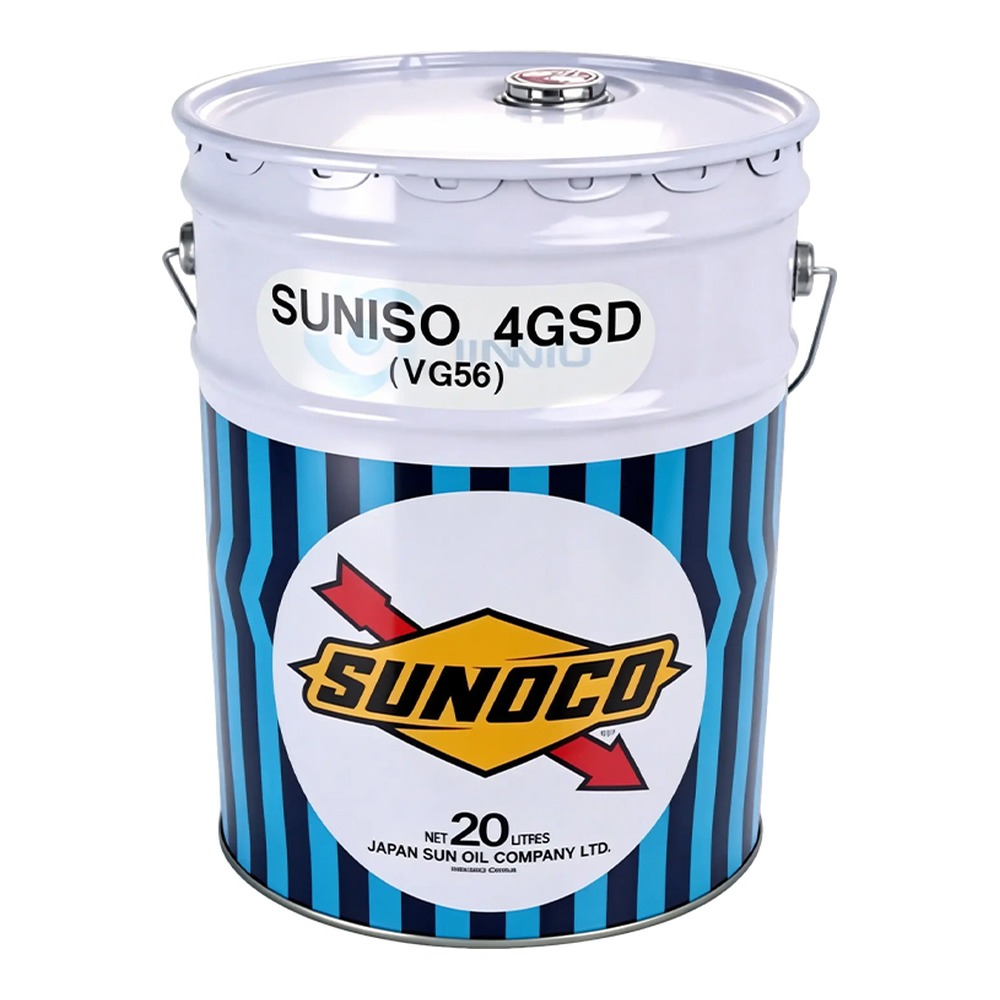
Both 4GS and 4GSD carry (VG56) on the pail, and DIN ISO 3448 has no VG 56 class. The VG 46 band ends at 50.6 cSt and the VG 68 band starts at 61.2 cSt, so 54.9 and 54.5 cSt sit in the gap between them.
That is not a defect in the oil. It is a grade that the manufacturer classifies at a viscosity the ISO system does not have a band for, and the pail states it plainly. Ordering it as "VG 46" or "VG 68" is what goes wrong, because neither band contains the fluid.
The two 4 grade designations differ by 0.4 cSt at 40 °C, 0.1 cSt at 100 °C, and 6 K of flash point: 188 °C for 4GS against 182 °C for 4GSD. Pour point is −35.0 °C on both.
5GS and 5GSD are the pair where the two designations diverge most. Viscosity moves from 94.6 to 96.5 cSt, still inside the VG 100 band on both. The flash point drops from 208 °C to 188 °C, twenty kelvin, and the pour point rises from −27.5 °C to −25.0 °C.
So the D is not a uniform substitution across the range. At 3 grade the two are indistinguishable on the published table. At 4 grade the flash point moves 6 K. At 5 grade it moves 20 K, and the low-temperature end moves with it.
A plant that has qualified 5GS for a duty and switches to 5GSD to solve a foaming complaint is also accepting a flash point 20 K lower and a pour point 2.5 K higher. That is a different fluid on the two properties that matter most at the heavy end of the range.
| Pair | 40 °C change | 100 °C change | Flash change | Pour change |
|---|---|---|---|---|
| 3GS to 3GSD | 0.0 cSt | +0.1 cSt | 0 K | 0 K |
| 4GS to 4GSD | −0.4 cSt | +0.1 cSt | −6 K | 0 K |
| 5GS to 5GSD | +1.9 cSt | +0.3 cSt | −20 K | +2.5 K |
Read down the flash column and the pattern is the point of this article: the same one-letter change costs nothing at 3 grade, 6 K at 4 grade and 20 K at 5 grade.
The GSD grades exist for one failure mode. When a compressor foams at start-up, oil leaves the sump with the discharge gas, and the bearing can run short of oil before the foam collapses. The enhanced antifoam package is specified to shorten how long the foam persists.
The GS grades carry a standard antifoam package, which is adequate where the machine does not foam. The distinction is not quality: a machine that starts cleanly gains nothing from the enhanced package, and a machine that foams is not fixed by a standard one.
That makes the choice a machine observation rather than a specification exercise. If the sight glass shows foam that persists after start-up, the GSD grade of the same number is the one specified. If it does not, the GS grade is the correct charge.
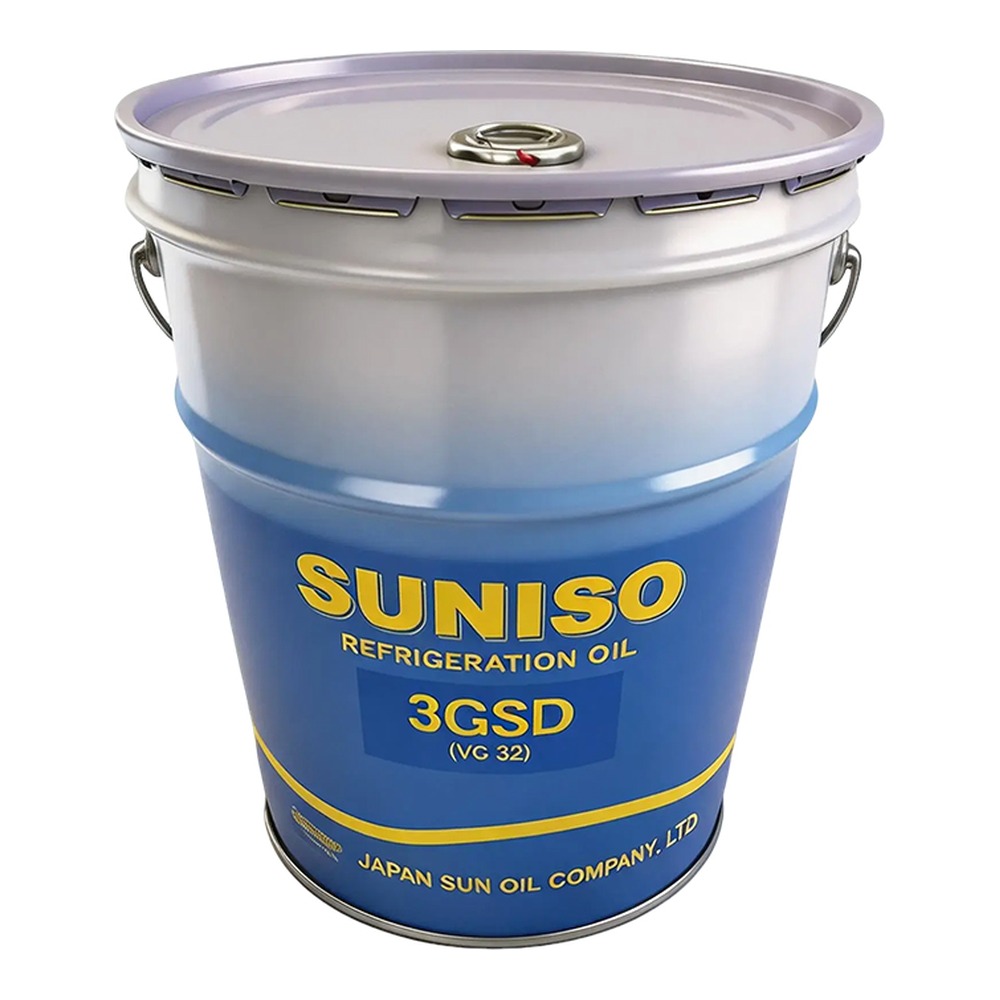
The Suniso pails state the grade and, where the manufacturer has one, the class. 3GSD carries (VG 32) under the grade letters. 4GSD carries (VG56), which is the manufacturer's class rather than an ISO band, and 4GS is sold under the same (VG56) class.
Pack format varies across the range rather than inside a pair: the 3 grade arrives in the 20 L pail with the grade and class printed on the white band around the shoulder, the 4 and 5 grades in jugs and pails carrying the same information on a label. What does not vary is the wording. The letter before the D is the whole difference, and it is printed in the same position on both packs of a pair.
That matters at the counter. Two pails of the same size, same brand and same colour band differ by one letter and by the antifoam package behind it, and the label is the only place the letter appears.
Viscosity is the wrong handle for this family, because 3GS and 3GSD share it, 4GS and 4GSD share it, and 5GS and 5GSD share it within 2 cSt. Two grades that behave differently in a sump carry numbers that differ by a single letter.
The handles that do separate them are the four published properties in the table above and the antifoam statement. A purchase order that names the grade in full, GS or GSD, and quotes the 40 °C figure, cannot be filled with the wrong one.
For the 4 grade there is a second trap. The pail says (VG56), and anyone converting that to an ISO class will find no such class and may substitute VG 46 or VG 68. Neither is the fluid. The measured 54.9 cSt is the number to give a supplier.
At 3 grade the substitution is close to free. The published properties are the same to the last digit that matters, and a plant that cannot tell its 3GS from its 3GSD is not risking much beyond the additive package it paid for.
At 5 grade the substitution carries two costs that a start-up foam complaint does not mention. The flash point falls from 208 °C to 188 °C, and the pour point rises from −27.5 °C to −25.0 °C. On a machine with a high condensing temperature the first is the flash margin, and on a machine that runs cold the second is the low-temperature end.
Neither figure is visible in the grade name. A purchase order that says 5GSD because the sump foamed has also accepted both, and the person raising it is usually looking at the foam rather than the data sheet.
Not the same, but close. The 40 °C viscosity is 54.5 cSt against 54.9 cSt, the pour point is −35.0 °C on both, and the flash point is 182 °C against 188 °C. The GSD grade carries the enhanced antifoam package.
It marks the enhanced antifoam package, specified for systems where foaming at start-up carries oil out of the sump. The GS grades carry the standard antifoam package.
Because the manufacturer classifies the 4 grade at a viscosity between the VG 46 and VG 68 bands, at 54.9 cSt and 54.5 cSt. DIN ISO 3448 has no band for that value, so the label carries the manufacturer's own class.
Only if the foaming complaint justifies it. The flash point drops from 208 °C to 188 °C and the pour point rises from −27.5 °C to −25.0 °C, so the heavy end of the range is where the two designations are least equivalent.
3GS and 3GSD are VG 32 at 29.5 cSt. 5GS and 5GSD are VG 100 at 94.6 and 96.5 cSt. The 4 grade sits between bands at 54.9 and 54.5 cSt.
Copyright & Citation Notice. This article is original content published by Qishanr Lubricants (qishanrlubricants.com). Viscosity, pour point, flash point and the antifoam specification are taken from the Sunoco Suniso grade documentation for each product listed. Quotation of up to 200 words is permitted with attribution and a link to this page. Reproduction in full requires written permission.