QSL is our own polyol ester line, seven grades from 18.9 to 215 cSt, all blended at our plant in Foshan. Five of the seven land inside the ISO 3448 band their number points at. Two do not, and both are worth knowing about before an order is placed.
The lightest grade measures under the floor of its own band. The 170 grade sits in the gap between two bands, in a class ISO does not have.
| Grade | 40 °C | 100 °C | ISO band | Pour point | Flash point |
|---|---|---|---|---|---|
| QSL-22H | 18.9 cSt | 4.2 cSt | Below VG 22 | −52 °C | 240 °C |
| QSL-32H | 33.3 cSt | 6.0 cSt | VG 32 | −50 °C | 235 °C |
| QSL-46H | 45.3 cSt | 7.1 cSt | VG 46 | −46 °C | 260 °C |
| QSL-68H | 66.6 cSt | 9.4 cSt | VG 68 | −39 °C | 270 °C |
| QSL-100H | 96.5 cSt | 11.3 cSt | VG 100 | −28 °C | 260 °C |
| QSL-170H | 170 cSt | 17 cSt | Between VG 150 and VG 220 | −25 °C | 290 °C |
| QSL-220H | 215 cSt | 18.8 cSt | VG 220 | −25 °C | 280 °C |
The VG 22 band runs from 19.8 to 24.2 cSt. QSL-22H measures 18.9 cSt, which is 0.9 cSt below the floor.
That is not a labelling error to correct by rounding. It is the grade we blend for the low-temperature end of the range, and the measured figure is the one that appears on the certificate of analysis that ships with the drum. A buyer comparing it against a specification written as VG 22 is comparing a name against a number, and the number is the honest one.
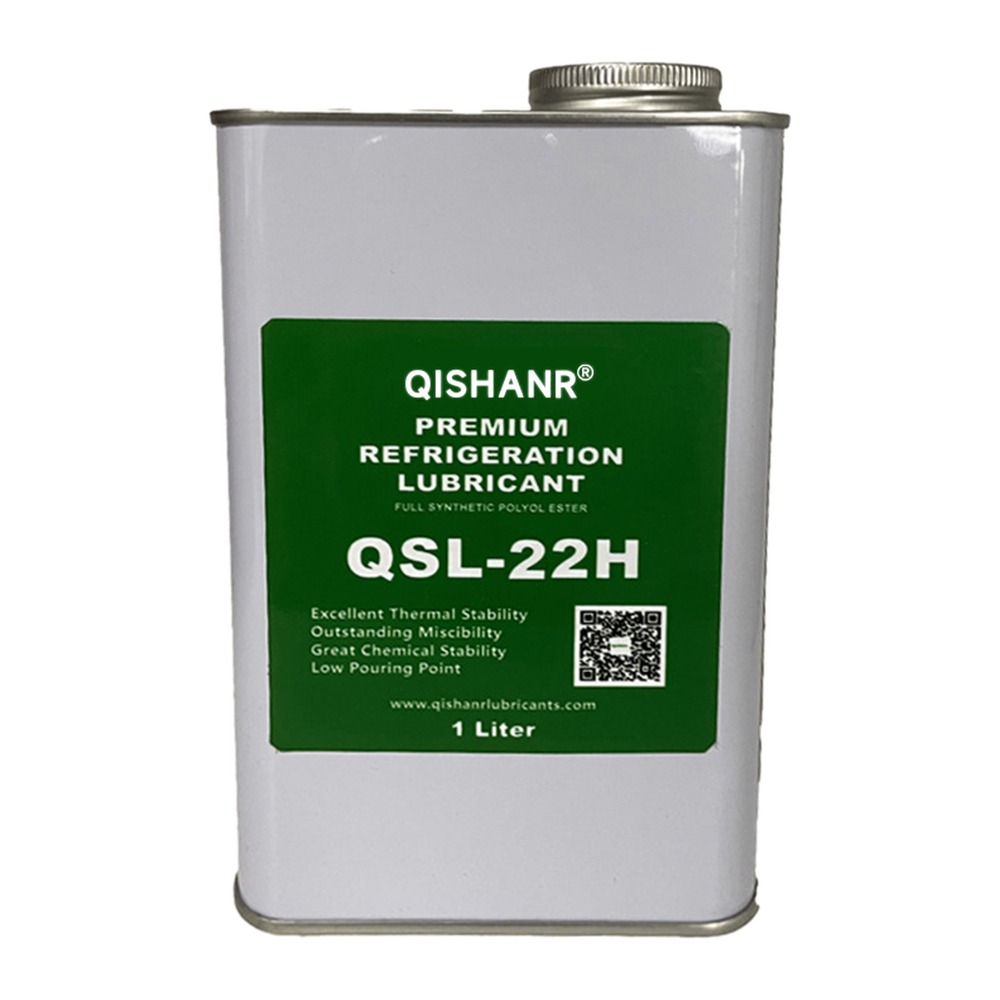
What the grade is for is the machine that runs cold. The pour point is −52 °C, the lowest of the seven, and a system whose evaporating temperature approaches that figure needs the miscibility and the flow checked before the charge is confirmed. That check is a conversation about the machine, not a line on a data sheet.
The VG 150 band ends at 165 cSt. The VG 220 band starts at 198 cSt. QSL-170H measures 170 cSt, so it sits above the first and below the second, in the gap.
The practical consequence is in the substitution. A specification that calls for VG 220 and receives 220H gets 215 cSt. A system sized around 170 cSt and filled with 220H is running 45 cSt thicker than designed, which shows up at the bearings and in the return, not on the invoice.
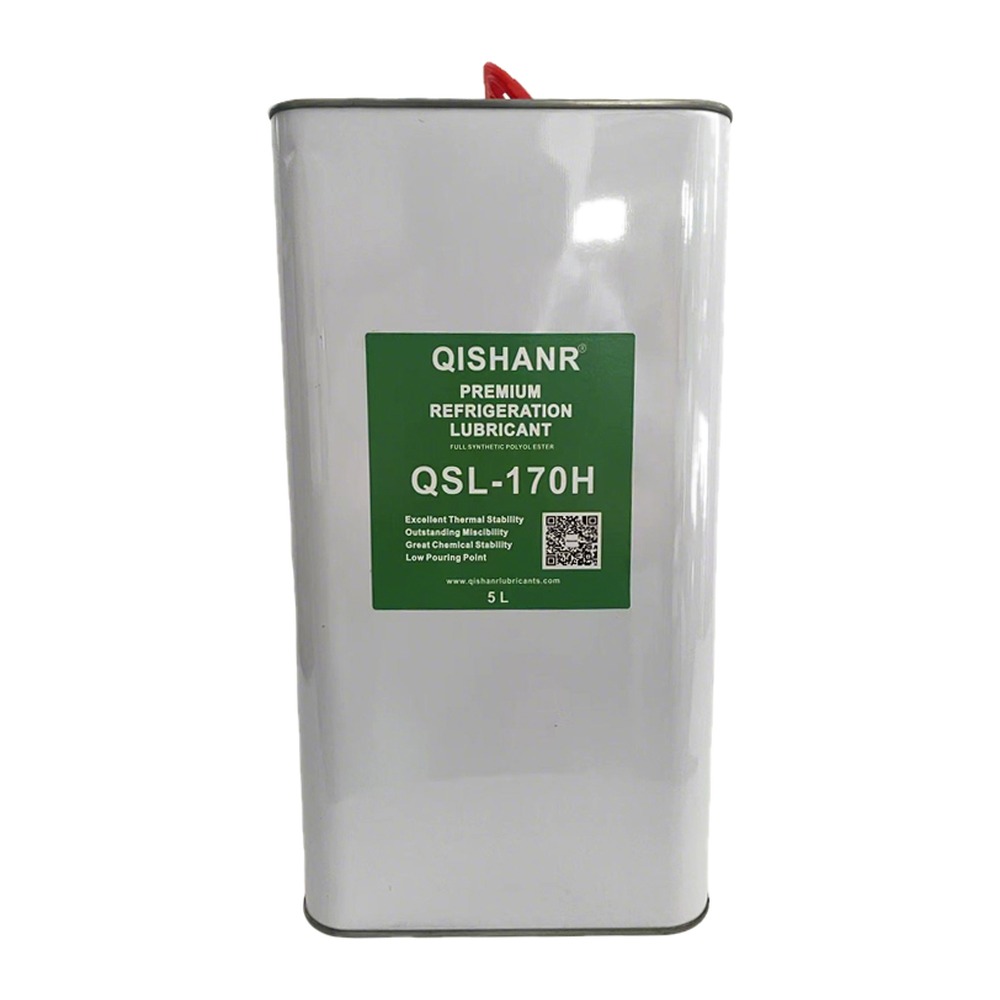
This grade earns its place at the heavy end of the range: high condensing temperatures, heavy loads, compressors whose bearings want more film than a 100 grade holds. It is a deliberate step between two ISO classes rather than a rounding of either.
| Grade | Measured | Nearest band edge | Distance |
|---|---|---|---|
| QSL-22H | 18.9 cSt | VG 22 floor, 19.8 cSt | 0.9 cSt below |
| QSL-170H | 170 cSt | VG 150 ceiling, 165 cSt | 5 cSt above |
| QSL-170H | 170 cSt | VG 220 floor, 198 cSt | 28 cSt below |
The two gaps are not the same shape. The 22H misses its floor by less than one centistoke, the smallest gap in the line. The 170H sits five centistokes above the ceiling below it and twenty-eight below the floor above it, so there is no band that contains it and no band it is close to.
Across the seven grades the pour point runs from −52 °C to −25 °C, a spread of 27 kelvin, and it moves in one direction as the grade gets heavier. That is the number to select on when the machine runs cold, because it is the number that decides whether the oil is still moving at the evaporating temperature.
The 40 °C viscosity is the number that decides load carrying. The two do not move together evenly: the jump from 22H to 32H costs 2 K of pour point, while the jump from 100H to 170H costs 3 K and adds 74 cSt.
A low-temperature system that needs more film than 22H provides cannot simply take the next grade up without checking what it gives away at the cold end. On this line the first step gives up 2 K, and the steps above it give up more.
The flash points run 240, 235, 260, 270, 260, 290 and 280 °C up the range. The lowest figure belongs to 32H, not to the lightest grade, and the highest belongs to 170H, not to 220H.
Two things follow. A buyer cannot infer thermal headroom from the grade number, and a machine running a high condensing temperature needs the flash figure from the row rather than an assumption about thicker oil being more heat resistant.
The values are close enough across the middle of the range that the flash point rarely decides a grade on its own. At the two ends it can: 32H at 235 °C is the lowest in the line, and 170H at 290 °C the highest.
QSL-220H measures 215 cSt at 40 °C and 18.8 cSt at 100 °C, with a viscosity index of 98 and a density of 0.975 at 20 °C. The pour point is −25 °C and the flash point 280 °C.
It is the top of the range: 215 cSt at 40 °C is the thickest of the seven. Its pour point is the highest in the line, which is the trade the heavy end of a POE range makes.
The line is built for HFC systems, with R-134a, R-404A, R-407C and R-410A the common charges, and it is used with HFO and CO2 systems on many modern compressors. Miscibility with the refrigerant is the first question, because a POE that separates from the charge does not return from the evaporator.
The second question is the compressor. The grade is confirmed against the machine model rather than picked off the table, and the model, the refrigerant and the duty are what that confirmation is based on.
The third is the refrigerant charge and the pipe run. A long return line on a low-temperature system puts a premium on the thin end of the range, and the pour point and miscibility of the 22H are what make that possible.
These are our own production, blended at our plant in Foshan. The minimum order quantity is not a fixed figure: it is set per order against the grade and the pack, and confirmed in writing before production.
Single packs and bulk are both available, in our own QISHANR container or in a buyer's own branded pack. The 22H is stocked in the 1 L can and the 170H in the 5 L can, and the rest of the range follows the same pack options.
Supply capacity on a single grade is 10,000 pieces a year, which is the figure to plan a distribution agreement around rather than a catalogue order.
Two of the seven are worth a second look before the order is released. The 22H is the grade where the number and the certificate disagree by less than a centistoke, and the 170H is the grade where they disagree by a whole class in both directions. Everything between them is a straight match between name and band.
The check that resolves both is the same: put the measured figure next to the specification rather than the grade name. A specification written as VG 22 against 18.9 cSt is a 0.9 cSt question, and a specification written as VG 220 against 170 cSt is a 45 cSt question. The first is a question about one centistoke, the second about whether the machine was sized for the oil at all.
It measures 18.9 cSt at 40 °C, and the VG 22 band starts at 19.8 cSt. It is the lightest grade in the line and the figure on the certificate is 18.9.
DIN ISO 3448 has no 170 class. The VG 150 band ends at 165 cSt and VG 220 starts at 198 cSt, so 170 cSt sits between the two. QSL-170H is a deliberate step between them.
The pour point decides it. QSL-22H pours at −52 °C and QSL-32H at −50 °C, and the choice between them is the film the compressor needs against the cold end the system runs at.
No. QSL-32H is the lowest at 235 °C and QSL-170H the highest at 290 °C, with QSL-220H at 280 °C below it.
It is set per order against the grade and the pack, and confirmed in writing before production. Single packs and bulk are both available, including in a buyer's own branded container.
Copyright & Citation Notice. This article is original content published by Qishanr Lubricants (qishanrlubricants.com). Viscosity, pour point and flash point figures are the published values for each QSL grade. Quotation of up to 200 words is permitted with attribution and a link to this page. Reproduction in full requires written permission.